What Does Clavicular Mean? Anatomy, Definition, and Why It's Trending
Learn what clavicular means, where the clavicle is, how it supports the shoulder, and why Google searches spiked around Braden Peters in September 2026.
Updated: September 22, 2026 · U.S. Google Trends snapshot and news context checked on this date
Short answer: Clavicular is an adjective meaning “of or relating to the clavicle,” the medical name for the collarbone. The clavicles are the paired, S-shaped bones across the upper chest that connect the breastbone to the shoulder blades. In the current U.S. Google Trends spike, however, the strongest verified context is not a new medical discovery. Google Trends connects clavicular with Braden Peters, the online name of a streamer and influencer, while current news reports are covering a Massachusetts criminal case involving him. The charges are allegations, not a finding of guilt.
What Does Clavicular Mean? Anatomy, Definition, and Why It's Trending
The word clavicular has a straightforward anatomy meaning: it describes something related to the clavicle, or collarbone. You may see it in phrases such as “clavicular region,” “clavicular fracture,” or “clavicular head of a muscle.” In everyday language, those phrases usually refer to the area around the collarbone.
The term is trending for a separate, current-events reason. When checked on September 22, 2026, Google Trends' U.S. Trending Now page showed clavicular as an active trend with 20K+ searches, a reported 1,000% increase, and a related search for Braden Peters. Google Trends reflects search activity rather than medical importance, and a fast-moving trend can cool just as quickly.
What Does Clavicular Mean?
Merriam-Webster defines clavicular as “of or relating to the clavicle.” The related noun, clavicle, means the bone commonly called the collarbone.
The difference is grammatical:
- Clavicle: the bone itself.
- Clavicular: an adjective describing that bone or the area, joint, muscle, or symptom associated with it.
For example, “clavicular pain” means pain in or around the collarbone area. It does not identify a specific diagnosis. Similarly, “clavicular anatomy” means the structure and relationships of the collarbone.
What Is the Clavicle?
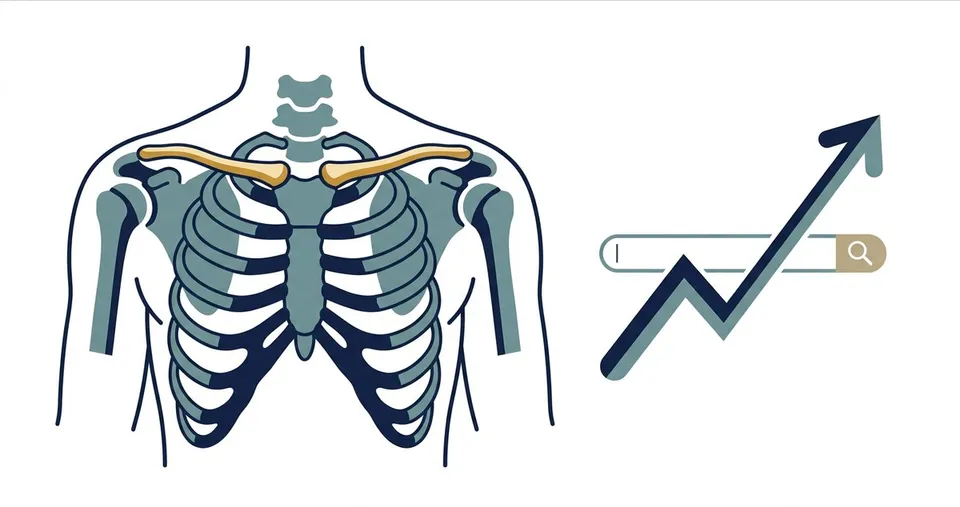
The clavicle is a paired bone: most people have one on the left and one on the right. Each one runs horizontally near the base of the neck, just above the first rib. You can usually feel it under the skin from the top of the chest toward the shoulder.
As Encyclopaedia Britannica explains, the clavicle is an S-curved bone of the shoulder, or pectoral, girdle. Its inner end meets the sternum, or breastbone. Its outer end meets the acromion, a projection of the scapula, or shoulder blade. These connections help link the upper limb to the central skeleton.
In simple terms, the collarbone acts like a supportive brace. It helps hold the shoulder away from the chest so the arm can move through a wide range of positions. Muscles and ligaments also attach to it, so the clavicle participates in shoulder and upper-chest movement even though it is not the shoulder joint itself.
Why Is “Clavicular” Trending Right Now?
The exact cause of a Google Trends spike cannot be proven from the trend graph alone. Google Trends shows what people are searching for and displays related queries and news, but it does not certify why every person searched.
In this case, the best-supported explanation is a wave of news coverage about Braden Peters, an online personality known as Clavicular. The Google Trends panel listed “braden peters” as the related search and linked to contemporaneous coverage from The Bulwark, The New York Times, and The Guardian.
CBS News reported that Massachusetts court records list one count of rape, one count of drugging someone for sexual intercourse, and one count of procuring liquor for someone under 21. CBS said the alleged offenses were dated May 23, 2025, the charges were filed on September 8, 2026, and an arraignment was scheduled for October 14 in the Chatham jurisdiction.
There is an important legal distinction here. The charges are allegations and do not establish that Peters committed an offense. CBS reported that a spokesperson for Peters called the charges “bogus,” said he had not been served with an arrest warrant, and that Peters denied the allegations. CBS also noted that the latest criminal-court documents did not say whether the alleged victim in that case was the same person involved in a separate Florida civil lawsuit. The Guardian likewise described the criminal matter as pending and reported the scheduled October arraignment.
So the responsible conclusion is: the current trend is strongly associated with breaking news about the online name “Clavicular,” not evidence that the anatomical word itself suddenly became medically important. That explanation may change as the news cycle develops, so this section should be updated if court records or reliable reporting add verified information.
Clavicular Anatomy Explained
Location
The clavicle sits at the front of the shoulder girdle. Its medial, or inner, end is next to the sternum. Its lateral, or outer, end is next to the acromion of the scapula. The two bones form a bridge between the trunk and each shoulder.
Joints and nearby structures
The inner end forms the sternoclavicular joint with the manubrium, the upper part of the sternum. The outer end forms the acromioclavicular joint with the scapula. Ligaments help stabilize both ends, while muscles including parts of the pectoralis major, deltoid, trapezius, and sternocleidomastoid attach in the clavicular region.
The clavicle also lies in front of important nerves and blood vessels that travel between the neck and arm. That is one reason a significant injury around the collarbone should not be self-assessed from a search result or an image alone.
Role in shoulder movement
The clavicle helps position the scapula and keeps the upper limb slightly away from the rib cage. This arrangement gives the shoulder room to elevate, rotate, and reach. A research overview indexed by PubMed describes the clavicle as connecting the axial and appendicular skeletons and contributing to upper-extremity function and range of motion.
The bone is also a common site of injury. A fall onto the shoulder, a collision, or force transmitted through an outstretched arm can damage the clavicle or nearby joints. The mechanism and symptoms matter, but only a qualified clinician can determine what an individual injury represents.
Common Clavicle-Related Questions
Where is the clavicle?
The clavicle is the collarbone. It runs from the upper sternum to the shoulder blade on each side of the body, just below the neck and above the first rib.
Is the clavicle a bone?
Yes. The clavicle is a long, curved bone and part of the shoulder girdle. There is one on each side.
What is the clavicle used for?
It helps support and position the shoulder, connects the upper limb to the trunk, provides attachment points for muscles and ligaments, and helps the arm move freely.
What does clavicular pain mean?
It is a location-based description, not a diagnosis. Pain near the collarbone can follow an impact, overuse, a muscle or joint problem, or another cause. Persistent, severe, or unexplained pain should be assessed by a healthcare professional.
What can cause pain around the collarbone?
Possible causes include an injury, a fracture, irritation around the sternoclavicular or acromioclavicular joint, or strain in nearby muscles. Similar pain can also be felt from structures around the shoulder or chest. A person should not use a keyword, symptom list, or AI response to diagnose themselves.
When should someone seek medical attention?
After an injury, seek prompt medical advice for severe pain, major swelling or bruising, an obvious change in shoulder shape, inability to use the arm normally, or a suspected fracture. The American Academy of Orthopaedic Surgeons lists common fracture signs such as pain, a bump or deformity, bruising, swelling, and difficulty moving the arm.
Get emergency help for bone breaking through the skin, heavy bleeding, chest pain, difficulty breathing, a hand or arm that becomes cold or unusually pale or blue, or new numbness or weakness. The NHS broken-collarbone guidance and Mayo Clinic information give similar urgent-care warnings. This article is general education, not medical advice or a diagnosis.
Understanding Clavicular Information With AI Tools
AI and online utilities can make technical information easier to organize, but they should support—not replace—qualified medical care. A safe workflow is to start with a reliable source, use a tool to improve readability, and then check the original source and ask a healthcare professional about personal concerns.
For example, readers can use the live ChatGPT directory entry as a starting point for rewriting a public anatomy explanation into plain language or organizing study notes. Do not treat an AI response as a diagnosis, and be careful about entering private health information.
For current-source research, the Perplexity directory entry can help users find and follow citations. Open the cited medical or government source rather than accepting a generated summary without checking it.
If a public medical handout is scanned, the PDF OCR tool can help extract text for personal reading. OCR can misread words, dosages, or labels, so extracted text should be compared with the original document. For a non-diagnostic educational illustration, the Canva AI directory entry can lead to visual-design tools, but any anatomy labels should be reviewed against a trusted medical reference.
FAQ: Clavicular and Clavicle Questions
What is the simplest clavicular definition?
Clavicular means related to the clavicle, or collarbone.
Is the clavicle the same as the collarbone?
Yes. Clavicle is the anatomical term; collarbone is the everyday name.
Why is “clavicular” trending in Google searches?
On September 22, 2026, Google Trends connected the active U.S. trend with the related search “Braden Peters.” Current reporting indicates that “Clavicular” is also an online name associated with Peters and a pending Massachusetts criminal case.
Does the trend prove that the search is about anatomy?
No. The trend panel shows search activity, not the intent of every searcher. The related query and news links suggest that the current spike is primarily news-driven.
Where is the clavicle located?
It is the horizontal bone between the upper sternum and the shoulder blade, just below the neck.
Can AI diagnose a clavicle injury?
No. AI can summarize general information, but it cannot replace an examination, imaging, or professional medical advice.
When is clavicle pain urgent?
After an injury, urgent care is warranted for severe pain, deformity, inability to use the arm, numbness, a cold or discolored hand, an open wound, chest pain, or difficulty breathing.
Medical-information disclaimer
This article explains vocabulary and basic anatomy for general education. It does not diagnose clavicular pain, recommend treatment, or replace an examination by a licensed healthcare professional. Seek qualified medical advice for persistent, severe, worsening, or concerning symptoms, and seek emergency care for serious injury, breathing difficulty, chest pain, heavy bleeding, or changes in arm circulation or sensation.
Sources and update note
The trend observation was checked on September 22, 2026, for the United States and the past 24 hours. Google Trends values and related queries are time-sensitive and may change. The current-events context was checked against the Google Trends news panel and reporting from CBS News, The New York Times, and The Guardian. Anatomy and health information was checked against Merriam-Webster, Encyclopaedia Britannica, PubMed, AAOS, NHS, and Mayo Clinic.
- Google Trends: clavicular, United States
- Merriam-Webster: clavicular definition
- Encyclopaedia Britannica: clavicle anatomy
- PubMed: Anatomy, Shoulder and Upper Limb, Clavicle
- CBS News: current Massachusetts charges and response
- The New York Times: current case reporting
- The Guardian: current case reporting
- AAOS: clavicle fracture signs
- NHS: broken collarbone urgent guidance
- Mayo Clinic: broken collarbone symptoms and complications
Continue reading
Related guides
GPA Calculator: How to Calculate CGPA in Pakistan Universities (2026)
Calculate GPA & CGPA on 4.0 scale for LUMS, UET, Karachi University — semester & cumulative.
Read article →
Best AI Tools for Students in 2026: Study, Research, and Math
“Best AI for writing,” “math,” and essay help are among Google’s leading AI searches. Here is a practical, responsible student workflow.
Read article →
Why Lynx vs. Fever Is Trending on Google Today: WNBA Playoff Stakes and Olivia Miles
Google Trends shows lynx vs fever among the fastest-rising U.S. searches. Here is what the WNBA matchup means, who is involved, and what the live trend does—and does not—tell us.
Read article →