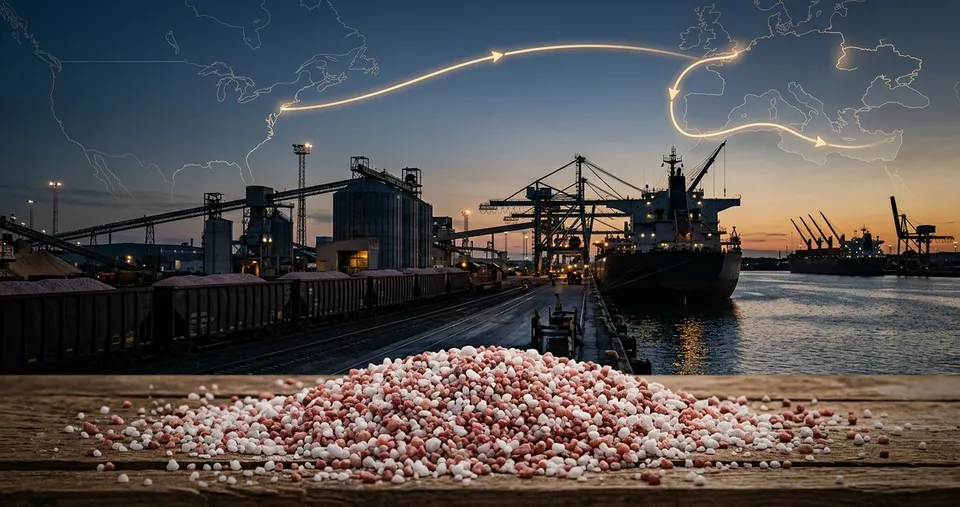
Potash Prices and the U.S.–Belarus Supply Debate: What the Canada Reliance Means in 2026
Potash became a U.S. trending search after President Trump said Washington was working on a large Belarus purchase at a lower price than Canadian supply. Here is what is confirmed, what remains reported, and why Canada, logistics and sanctions matter.
Introduction
Potash became one of the United States’ fastest-rising Google searches on September 21, 2026, after U.S. President Donald Trump said Washington was working on a “massive deal” to buy potash from Belarus at a price below what the United States pays Canada. Google Trends showed potash at 2K+ searches, up 400% and still active in the U.S. four-hour view when checked on September 21. A search spike shows attention, not whether people support or oppose the proposal.
The important distinction is between a political statement, a reported trade discussion and a signed supply contract. The current reporting identifies no final tonnage, buyer, seller, delivery route, payment structure, price formula or shipment schedule. This article explains what is confirmed, what is reported and what could happen if a compliant Belarusian supply route is actually arranged.
Research and market snapshot: September 21, 2026. Commodity prices use different grades, locations and delivery terms, so the basis and date are shown rather than presented as one universal “potash price.”
What triggered the potash search?
In a report published at 11:00 a.m. EDT on September 21, CP24 reported that Trump said on Truth Social that the United States was working on a large Belarus purchase and that the pricing would be substantially below current Canadian purchases. The report described this as a statement about a deal in progress, not evidence that a commercial contract had been completed.
That claim matters because potash is not a discretionary consumer product. It is a potassium fertilizer input used to help crops manage water, grow roots and maintain yields. Replacing a nearby supplier with a distant, geopolitically sensitive source would involve more than comparing two mine-gate prices.
Confirmed, reported and possible: the fact check
| Status | What the evidence supports |
|---|---|
| Confirmed | Canada is the leading potash producer and exporter. Natural Resources Canada reports 22.916 million tonnes of Canadian exports in 2024, equal to 38.7% of world exports; the United States received 53% of those Canadian exports. |
| Confirmed | The U.S. Geological Survey estimated 2024 U.S. potash production at 420,000 tonnes, imports at 6.1 million tonnes and apparent consumption at 6.4 million tonnes. Its estimated net import reliance was 93%. |
| Reported | Trump said the United States was working on a large Belarus purchase at a lower price than Canadian supply. No public contract details were verified in the current sources reviewed. |
| Possible | A completed and legally permitted deal could diversify U.S. sourcing or improve negotiating leverage. It would not automatically make delivered fertilizer cheaper because freight, port handling, rail, financing, insurance and compliance costs would still matter. |
The Canadian and USGS figures are useful for showing dependence, but they are not identical measurements. Natural Resources Canada’s trade tables use tonnes of potassium chloride, while the USGS statistics are generally reported in tonnes of potassium oxide equivalent. They should not be added together as if they were the same unit.
Why Canada is central to the U.S. fertilizer supply
Natural Resources Canada says all 10 active Canadian potash mines are in Saskatchewan. Its 2024 production estimate was about 25 million tonnes of muriate of potash, and its export table lists the United States as the destination for 53% of Canadian exports. Canada also has the largest reported potash reserves, at about 1.1 billion tonnes of potassium oxide equivalent.
The USGS Mineral Commodity Summaries 2025 potash report provides a second view of the U.S. exposure. For 2020–2023, it estimated U.S. potash import sources at Canada 79%, Russia 11%, Belarus 4%, Israel 3% and other sources 3%. The report also states that no practical substitute exists for potassium as an essential plant nutrient, although low-potassium materials such as manure and greensand can serve limited local roles.
These figures explain why Canada–U.S. trade headlines can move beyond diplomacy. A disruption would affect farm input procurement, while a new supplier would have to meet the required volume, grade and delivery schedule at a workable landed cost.
What current potash prices actually show
There is no single global cash price called “the potash price.” MOP may be quoted as a retail price per U.S. short ton, a free-on-board export price per metric tonne, a delivered price or a contract price. The following snapshots are therefore kept separate.
| Measure | Latest verified figure | How to read it |
|---|---|---|
| U.S. retail fertilizer | DTN reported $494 per ton for the first full week of September 2026. | DTN said this was 1% above the previous month and 1% above a year earlier. This is a retail snapshot, not a mine or seaborne benchmark. |
| World Bank standard-grade MOP | YCharts’ World Bank series showed $386.90 per metric tonne for August 2026, updated September 3. | The series was down 2.42% from July’s $396.50 and up 8.53% from August 2025’s $356.50. It is standard-grade, FOB Vancouver, not a U.S. farm-delivered price. |
| Longer-term context | Natural Resources Canada reports a 2024 average of about US$295 per tonne for its price series. | The Canadian page identifies a different series basis, including Brazil CFR granular spot pricing from 2020 onward. It should not be compared directly with the DTN retail figure. |
As of the research date, a freely accessible, time-stamped U.S. NOLA granular MOP quote that could be cleanly compared with the reported Belarus claim was not reliably available from the sources reviewed. That is why this article does not manufacture a current wholesale spread between Belarus and Canada.
Why a Belarus supply deal would be complicated
1. A headline price is not a delivered price
Canadian product can move into the United States through an integrated North American rail and distribution network. Belarus is landlocked. The September 21 report says Belarus has been barred from using Lithuania’s Klaipeda port since February 2022 and that existing exports have used routes involving Russia. A Belarus-to-U.S. cargo would need a workable combination of rail, port, ocean freight, insurance, unloading and inland delivery.
Those costs can narrow or remove an apparent mine-price discount. They can also vary by destination: a shipment to a Gulf port is not the same as a shipment delivered to an inland farm or a river terminal.
2. Sanctions and licenses are date-specific
It is not accurate to describe Belarusian potash as simply “open” or “closed” without naming the legal instrument and date. The current OFAC Belarus sanctions page continues to list an active Belarus sanctions program and was updated September 17, 2026. The active General License No. 14 linked there addresses certain Belarusian financial entities; it is not a blanket authorization for every potash transaction.
OFAC’s older General License No. 13 authorized specified transactions involving Belarusian potash entities when it was issued in December 2025, subject to its own limits. The current OFAC page does not present that license as an unrestricted, permanent return to normal trade. Any proposed shipment would need current sanctions, ownership, payment and routing checks by the parties involved.
3. Volume and timing are not yet known
“Massive” is a political description, not a tonnage. To estimate the market effect, readers would need the annual volume, product grade, contract duration, first shipment date, delivery point and whether the material is incremental supply or cargo redirected from another importing region. None of those details was verified in the September 21 reports reviewed.
What could happen to prices and farmers?
A completed Belarus arrangement could have several effects, and they do not all point in the same direction.
- Supply diversification: U.S. buyers could have another source on paper, reducing dependence on one neighboring exporter.
- Negotiating leverage: The possibility of alternative supply could change contract discussions with Canadian suppliers, even if the alternative never reaches full scale.
- Logistics premium: Longer routes and extra handling could make a low origin price less attractive after delivery.
- Regional rebalancing: If Belarusian cargo moves toward the United States, other buyers may compete for Canadian, Russian or Middle Eastern material.
- Policy risk: Sanctions, tariffs, export rules or payment restrictions could change the commercial calculation after a headline is published.
For growers, the relevant number is the price and availability of the required grade at the local distributor, not a quoted political comparison. For readers comparing metric tonnes, short tons or currencies, ToolshubUSA’s Unit Converter and Currency Converter can help with arithmetic. A percentage change can be checked with the Percentage Calculator; none of these tools predicts future fertilizer prices.
What to watch next
The next reliable update should answer practical questions rather than repeat the headline:
- Has a U.S. agency, Belarusian producer or American buyer published a signed agreement?
- What is the annual and initial shipment volume?
- Which current OFAC authorization or specific license covers the transaction?
- What route, port, Incoterm and delivered benchmark will be used?
- Are Canadian tariffs or other trade measures part of the negotiation?
- Do buyers actually book cargo, or does the discussion remain leverage in a Canada–U.S. dispute?
Until those facts are available, the strongest conclusion is narrower: the announcement puts U.S. fertilizer dependence and potash logistics back in the news, but it does not yet prove that Canada will be displaced or that U.S. farm-gate prices will fall.
Frequently asked questions
What did Trump say about Belarusian potash?
According to the September 21 CP24 report, Trump said the United States was working on a “massive deal” to buy Belarusian potash at a price substantially below what the United States currently pays Canada. The report did not include a finalized contract or shipment schedule.
Has the United States signed a potash deal with Belarus?
A completed commercial agreement was not verified in the current sources reviewed. The statement should be treated as a reported negotiation or proposal until the parties publish the volume, terms, route and legal authorizations.
How dependent is the United States on imported potash?
The USGS estimated 2024 net import reliance at 93% of apparent consumption. It also estimated 6.1 million tonnes of imports against 6.4 million tonnes of apparent consumption. The USGS reports its figures in potassium oxide equivalent, so the unit basis matters.
Why is Canadian potash so important to the United States?
Canada is close to the U.S. market, has large reserves and is the world’s leading potash exporter. Natural Resources Canada says the United States received 53% of Canadian potash exports in 2024. USGS data for 2020–2023 put Canada at 79% of U.S. import sources.
What is the latest potash price?
It depends on the basis. DTN reported a U.S. retail average of $494 per ton for the first full week of September 2026. A World Bank-linked standard-grade FOB Vancouver series showed $386.90 per metric tonne for August 2026. These are different markets and units, so neither is a universal delivered U.S. price.
Are Belarusian potash shipments automatically legal now?
No blanket conclusion is supported. OFAC continues to list a Belarus sanctions program. General licenses and specific permissions are date- and entity-specific, and a transaction may still be restricted by ownership, payment, routing or other sanctions rules.
Could a Belarus deal lower U.S. fertilizer costs?
It could create a potential source of competitive pressure, but a lower delivered cost is not guaranteed. Freight, port access, rail, insurance, compliance, contract terms and the volume actually shipped would determine the real effect.
Sources and methodology
This article was researched on September 21, 2026. The news catalyst came from the CP24 report and the Google Trends U.S. snapshot. Supply and dependence figures came from Natural Resources Canada and the USGS. Retail and benchmark price context came from DTN and the World Bank-linked YCharts series. Sanctions language was checked against the current OFAC Belarus page and its linked license materials. Reported claims and possible outcomes are labeled separately from confirmed statistics.
- Google Trends: potash, U.S., past four hours
- CP24: Trump working on Belarus potash purchase, September 21, 2026
- Natural Resources Canada: Potash facts
- U.S. Geological Survey: Mineral Commodity Summaries 2025, Potash
- DTN: Fertilizer Prices Continue Lower for 6 of 8 Major Nutrients, September 16, 2026
- YCharts: World Bank potassium chloride MOP series
- OFAC: Belarus Sanctions
Continue reading
Related guides
Understanding Compound Interest: A Simple Guide
A = P(1+r/n)^(nt) with example.
Read article →
PSX Brokerage Calculator: How to Calculate Commission in Pakistan (2026)
Calculate PSX commission, CDC, LAGA & taxes for KSE-100 trades — with formula and example.
Read article →
Loan Calculator Pakistan: EMI, Interest & Schedule Explained
Calculate EMI, total interest & amortization schedule for home, car & personal loans in Pakistan.
Read article →